
中国梦之声
Grassroots official’s 30-year fight against desertification in North China_我的网站

A | 北京车企推出多款新车,小米汽车展台人气爆棚。
Ecological restoration
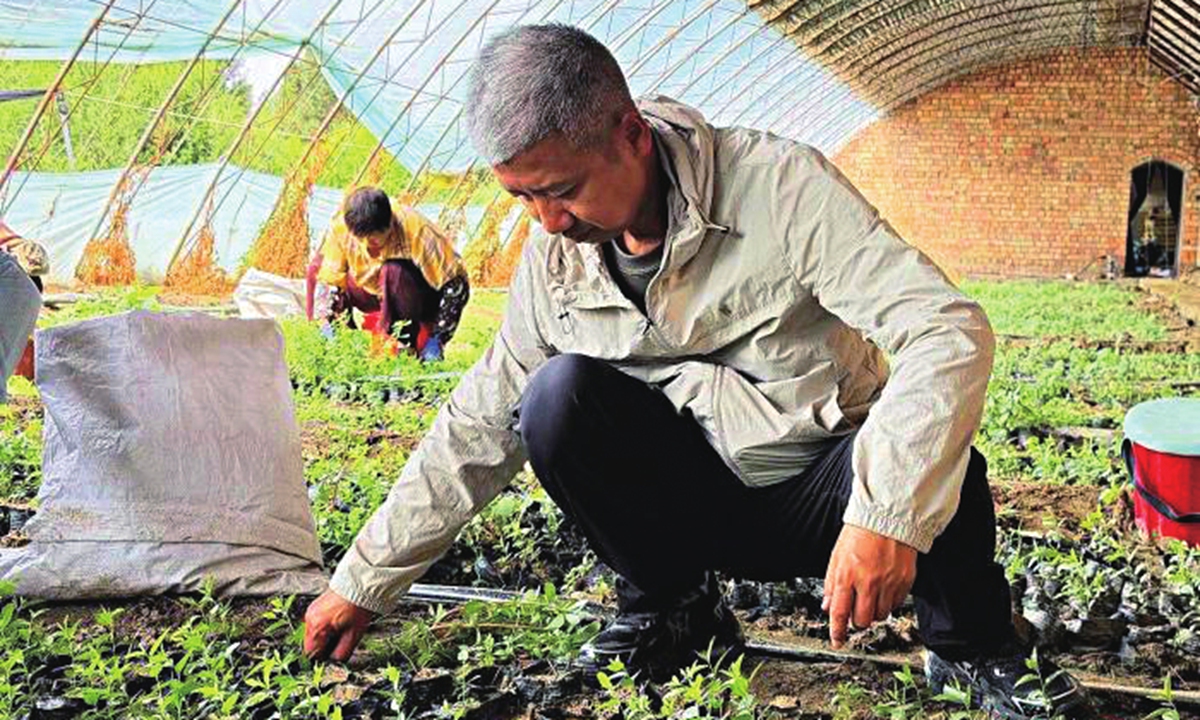
For over 30 years, Wensuyalatu, a member of the leadership group of the Urad Rear Banner forestry and grassland bureau, has made the Gobi Desert his workplace, dedicating his life to combating desertification, advancing ecological restoration through technological innovation, and helping local herders increase their incomes, according to the local bureau's official WeChat account.
Located on the edge of the desert in Bayannur's Urad Rear Banner, it is a key area in China's Three-North Shelterbelt Forest Program, a major ecological project aimed at strengthening the country's northern ecological security barrier.
However, early afforestation efforts in the desert were far from easy at the start.
The project covers 103,800 mu (about 6,920 hectares), including comprehensive treatment of 24,500 mu of desertified land, ecological restoration of 4,100 mu of non-desertified land, and 75,200 mu of enclosed grassland restoration. The project also includes the construction of 11 small-scale water conservation facilities, all of which required strict standards and extensive coordination.
The project also includes the construction of 11 small-scale water conservation facilities, all of which required strict standards and extensive coordination.
In 1991, Wensuyalatu, then in his early 20s, chose to devote himself to forestry and grassland conservation in the Urad Rear Banner. Since then, he has remained on the front lines of desertification control, witnessing the region's harshest environmental challenges and working to find solutions adapted to the fragile desert ecosystem.
In the early years, afforestation in the Gobi Desert was an extremely difficult task. The most critical planting season in spring often coincided with the strongest sandstorms of the year. Every year during the key afforestation period, Wensuyalatu would stay deep in the desert, guiding workers on planting techniques and management practices, while carefully overseeing every detail of the ecological restoration projects.
"Every spring, the wind and blown sand were so strong that it was hard to keep your eyes open. The sand hit your face like needles. During the day, we followed workers to dig holes and plant trees, and at night we stayed in temporary shelters to organize data and review the day's work. That was the normal routine for desertification fighters," Wensuyalatu recalled.
The road to restoring the desert was far from easy. Years of drought, low survival rates of seedlings, and skepticism from some local residents created major obstacles.
"At the beginning, it was really difficult. The climate was extremely dry, and many seedlings died after being planted. Some herders did not understand or support the work. They believed deserts were naturally barren and that no amount of effort could make trees grow there," Wensuyalatu said.
To change these perceptions, Wensuyalatu brought local residents to see firsthand the damage caused by desert expansion. Through visible results and long-term communication, he gradually won the understanding and support of the community.
Facing the ecological challenges of the Urad Rear Banner, Wensuyalatu began exploring new approaches beyond traditional restoration methods.
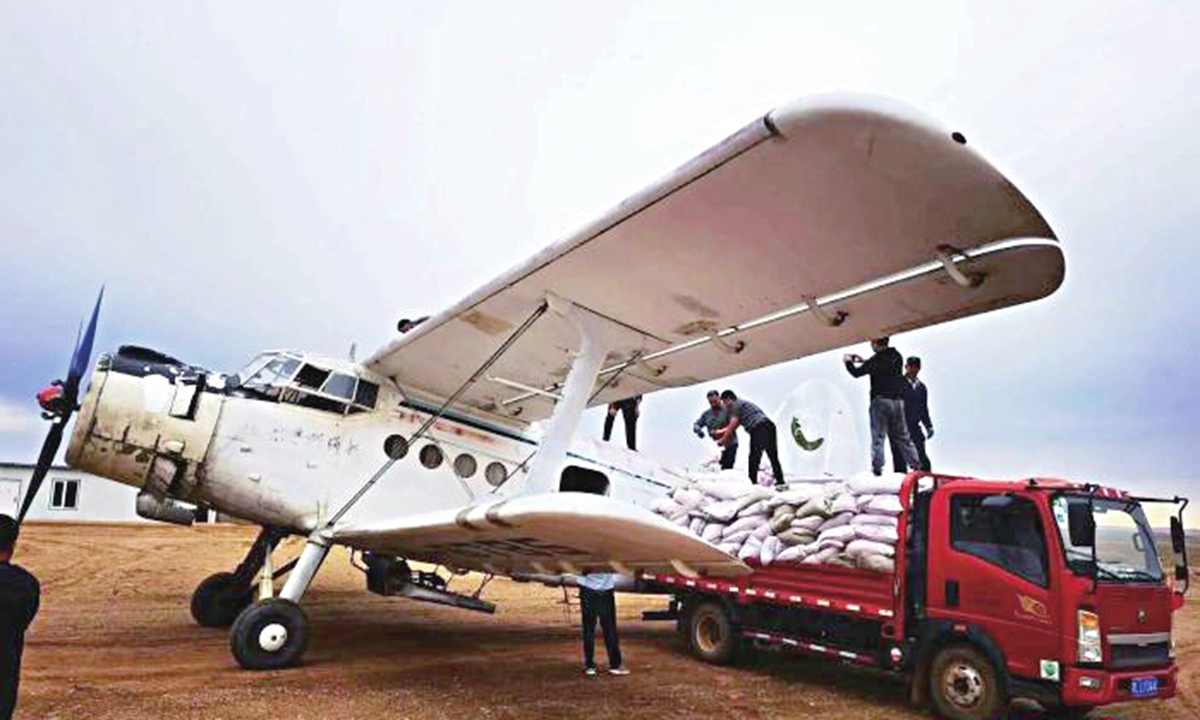
Since 2004, he has led efforts to tackle desert restoration challenges by introducing large-scale aerial seeding projects, creating a breakthrough approach for restoring degraded desert ecosystems in the region.
"Compared with traditional methods, aerial seeding is more efficient and can cover wider areas. Based on local climate and soil conditions, we select suitable desert plant seeds and precisely control the seeding height, density and timing to improve survival rates as much as possible and accelerate desert recovery," Wensuyalatu explained.
After years of effort, the aerial seeding projects under Wensuyalatu's leadership have restored more than 800,000 mu of desert land, with an effective restoration rate of 62.2 percent.
He also developed an integrated management approach combining "protection, management, retreat, restoration and publicity," establishing a mixed vegetation system of trees, shrubs and grass to curb desert expansion and reduce sandstorms at their source.
Beyond restoring greenery, Wensuyalatu has also focused on strengthening scientific research and protecting native desert species.
Starting in 2010, he devoted himself to the artificial cultivation of endangered native desert plants. After more than a decade of repeated experiments, he successfully developed cultivation techniques for rare species such as the endangered evergreen broadleaf shrub Ammopiptanthus mongolicus, Mongolian almond and drought-resistant elm.
Under his leadership, his team cultivated 6.5 million seedlings and completed more than 4,000 mu of high-quality afforestation projects, with seedling survival rates consistently exceeding 80 percent.
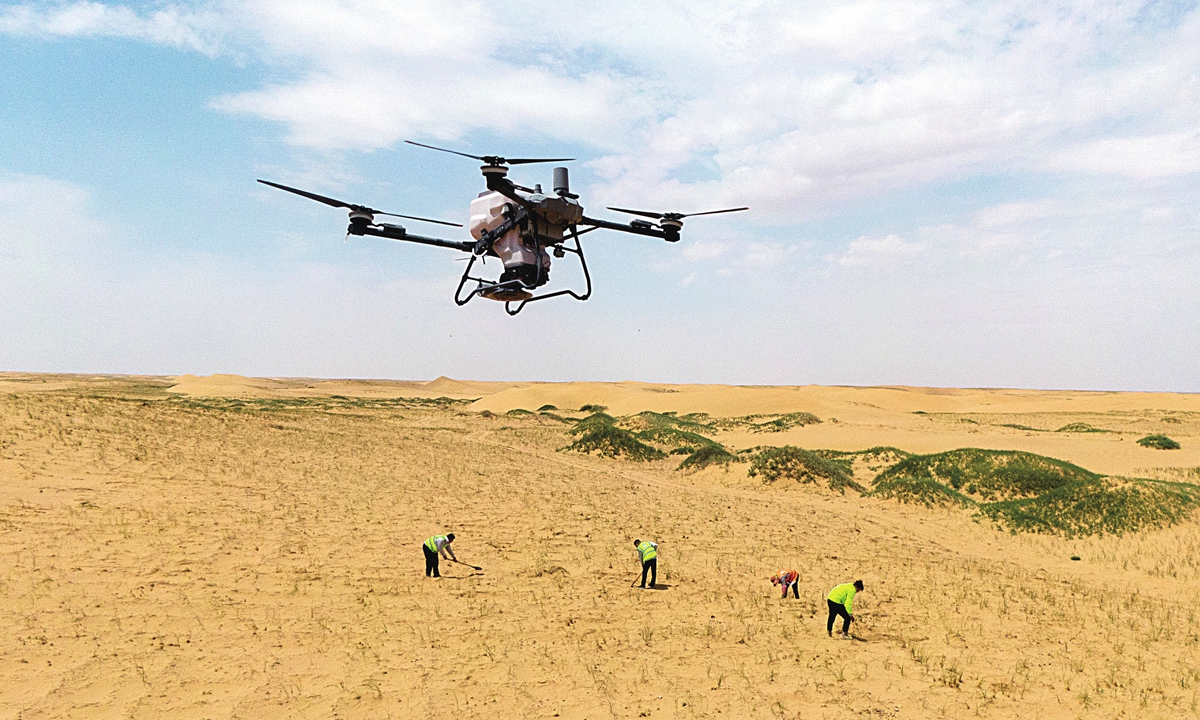
For Wensuyalatu, desert restoration is not only about creating ecological benefits, but also about improving people's livelihoods.
He has long promoted the idea that "trees should bring both ecological value and economic value." By leveraging local desert resources, he helped establish a 10,000-mu industrial base for desert plants and cistanche - a medicinal plant often grown in desert environments - across four key local villages, integrating ecological restoration with specialty desert industries.
"In the past, people thought desertification control was simply about planting trees - it took a lot of efforts but brought little income. Now things are different. By planting trees and developing industries such as cistanche cultivation, desert land can generate real wealth," a local herder said.
To ensure that local communities benefit from ecological development, Wensuyalatu introduced enterprises, supported family forest farms and professional cooperatives, and promoted large-scale, market-oriented operations.
The once barren desert has gradually become a "green treasure chest" for local herders, achieving a win-win outcome: greener landscapes, improved ecosystems, stronger businesses and higher incomes.
"Desertification control is not just an ecological project, but also a project that benefits people," Wensuyalatu said.
"Only when communities gain real benefits from protecting nature will they actively participate in ecological conservation. That is the key to making restoration efforts sustainable and achieving the vision that lucid waters and lush mountains are invaluable assets," Wensuyalatu said.
Global Times
。北京晚报记者 潘之望 摄 北京晚报讯(记者师悦)昨天(4月27日),北京国际汽车展览会迎来首个专业观众日。记者探访发现,国产新能源车吸引了众多参观者的关注,小米SU7展区等待参观的观众队伍更是排到了场馆外,需排队60分钟才能触摸到展车。 10时许,中国国际展览中心(顺义馆)里热闹非凡,国内外汽车厂商纷纷携旗下重磅车型或最新前沿技术亮相,多个品牌的国产新能源车受到观众的热捧。

B | 2020年就曾参加北京车展的刘先生十分感慨:“与4年前相比,这届车展新能源车占比明显多了。除了纯电动车,各种运用了增程式、插电混动等技术的新款新能源车层出不穷,市场认可度也越来越高。

C | ” 首次亮相北京车展的小米SU7成了展会上的“明星”。12时许,小米汽车展台旁,上百位等待参观的观众排起了长队,队伍转了三道弯,队尾已经排到了展馆外。接近队尾位置,放置的提示牌写着:“预计排队等候时间约为60分钟。

D | ” “这恐怕是今年北京车展最火的展台了,我已经排了40多分钟,终于快排到了。一个月前看了SU7的发布会,终于有机会零距离体验这款‘诚意满满’的车了。

E | ”即将进入小米汽车展区的胡先生兴奋地说。 在蔚来展台的“蔚来换电站”前,七八排观众正在观看换电机器人完成换电的全过程:车辆停好,换电机器人就会上升到车辆底盘下方,拧下车上的10颗高强度高可抗性螺栓。卸下的电池将转移至平台右侧缓存区域,同时,电池舱内一块满电电池将会传送至车身下方,再由换电机器人拧好螺栓。只需3分钟,就可完成一次换电。 现场工作人员介绍,目前,蔚来在全国已经布局了2400多座换电站,遍布城区和高速服务区。“高效的换电技术使换电和加油一样方便,会大大打消电动车车主的续航焦虑。

F | ” “这是款五座中大型SUV,采用红旗新能源全新设计理念……”红旗新能源品牌也吸引了众多年轻人的目光。

G | 本届车展首发的红旗EHS7,是红旗展台的热点车型之一,展车旁工作人员正热情地为参观者讲解着该车的性能和特色。 “配色大胆又吸睛,车身造型时尚又精致,就连大灯都很有辨识度,安全性能上也可靠。

H | ”参观完样车,观众连连称赞。
Current article:http://b7r.foujiongwenruapoumeizhan.buzz/0tb712q/20260826/4124.html
Published on:17:33:17
评论
-
关于我们 | 我的网站 版权所有
Copyright ? 2019 我的网站 All Rights Reserved